

Veterinary Surgery, Cardiology & Internal Medicine Near You in Los Angeles
When your dog or cat needs more than routine wellness care, finding a veterinary hospital that offers surgery, cardiology, and internal medicine under one roof can save precious time and reduce stress for everyone involved. In Los Angeles, pet owners are fortunate to have access to multi-specialty facilities staffed by board-certified veterinarians who collaborate daily on complex cases. This guide explains what each specialty involves, why having them together matters, and how to choose the right hospital for your pet's needs.
What Is a Specialty Veterinary Hospital?
A specialty veterinary hospital is a facility where board-certified veterinary specialists provide advanced diagnostics and treatments beyond the scope of general practice. These specialists complete rigorous residency training, typically three or more years after veterinary school, and earn credentials from organizations such as the American College of Veterinary Internal Medicine (ACVIM).
According to the AVMA's 2025 Pet Ownership and Demographics Sourcebook, 77.5 million U.S. households now own at least one pet, and veterinary care accounts for about 32% of total pet-related spending. As pet ownership grows, so does demand for advanced specialty services.
Veterinary Surgery: When Your Pet Needs an Expert
Veterinary surgery is the discipline focused on operative procedures ranging from orthopedic repairs to tumor removals. A board-certified veterinary surgeon holds credentials from the American College of Veterinary Surgeons (ACVS) after completing a three-year surgical residency.
Common Surgical Procedures
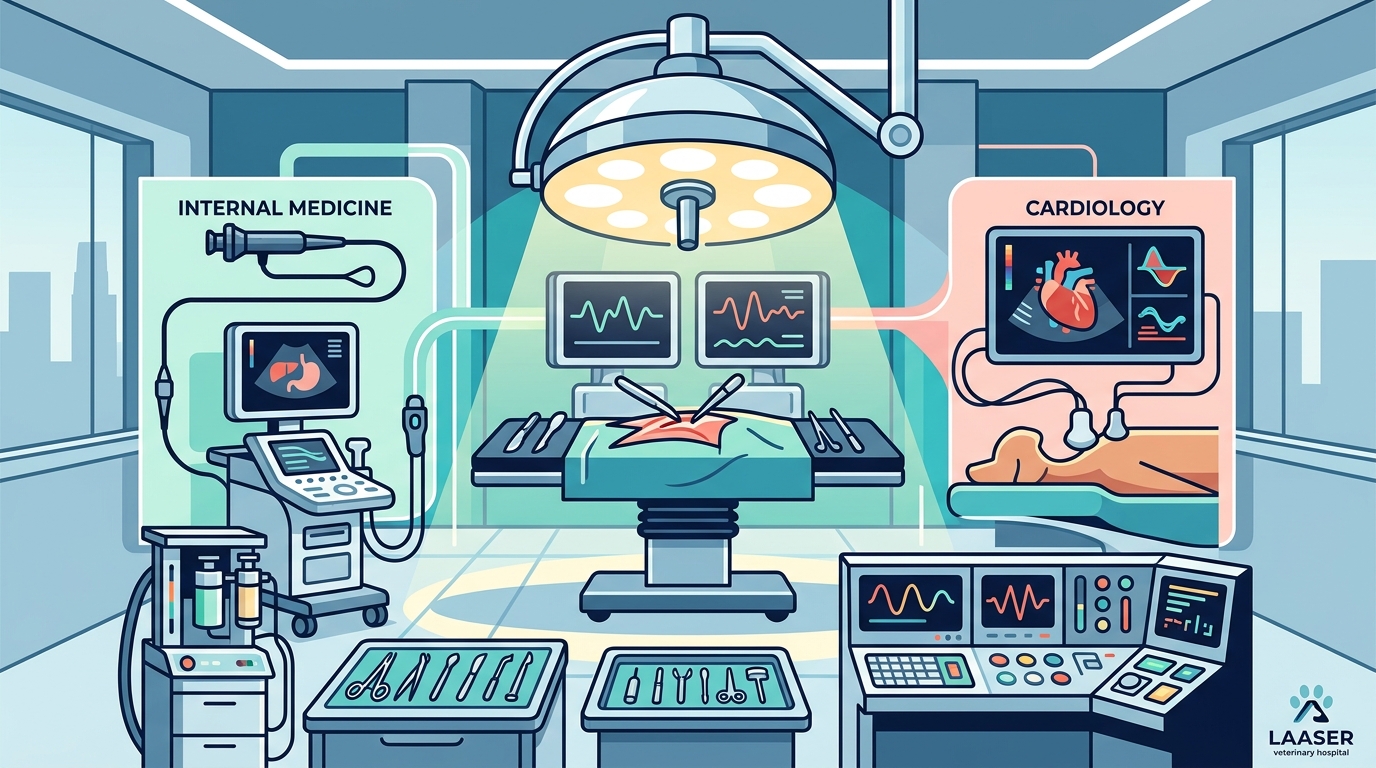
Specialty surgical teams handle joint stabilizations such as TPLO and CBLO, fracture repairs, soft-tissue mass removals, and emergency abdominal surgeries. At LAASER, the veterinary surgery department also takes internal transfers from the emergency, neurology, and internal medicine teams, ensuring continuity of care throughout a patient's stay.
Why a Full-Time Surgical Team Matters
Having a dedicated surgical team in a specialty hospital means faster scheduling for critical cases and seamless post-operative support. At facilities like LAASER, rehabilitation and clinical nutrition departments collaborate with the surgical team to support recovery.
Veterinary Cardiology: Protecting Your Pet's Heart
Veterinary cardiology is the specialty devoted to diagnosing and treating diseases of the heart and cardiovascular system. Cardiologists are board-certified through the ACVIM with a sub-specialty credential, DACVIM (Cardiology), after completing a dedicated three-year residency.
Conditions Treated
Veterinary cardiologists manage congestive heart failure, dilated and hypertrophic cardiomyopathy, hypertension, and congenital heart defects. LAASER's cardiology team uses advanced diagnostics including echocardiography, ECG and Holter monitoring, pacemaker implantation, and interventional techniques such as balloon valvuloplasty.
Meet a Board-Certified Cardiologist
Dr. Jordan Vitt, DVM, DACVIM (Cardiology), completed his cardiology residency at Texas A&M University and has served on the ACVIM Cardiology Examination committee. His expertise spans interventional cardiology, advanced cardiac imaging, and research.
Internal Medicine: Diagnosing Complex Conditions
Veterinary internal medicine is the specialty focused on non-surgical management of complicated and chronic diseases affecting organ systems. Internists hold the DACVIM credential and complete a three-year residency after veterinary school and a rotating internship.
LAASER's internal medicine specialists use advanced diagnostics such as endoscopy (bronchoscopy, gastroscopy, colonoscopy, rhinoscopy, cystoscopy), ultrasonography, and CT scans. These tools enable precise diagnosis and targeted treatment plans tailored to each patient.
Why Surgery, Cardiology & Internal Medicine Under One Roof Matters
Pets with complex conditions often need input from multiple specialists. A dog with a splenic mass, for example, may require surgical removal, cardiac clearance from a cardiologist, and post-operative monitoring by an internist. Having all three departments in one hospital eliminates referral delays and allows real-time collaboration.
| Benefit | Single-Specialty Clinic | Multi-Specialty Hospital |
|---|---|---|
| Cross-department collaboration | Requires external referrals | Immediate, in-house consults |
| Emergency support | Often unavailable on-site | 24/7 emergency & critical care |
| Diagnostic equipment sharing | Limited imaging options | CT, MRI, ultrasound, endoscopy on-site |
| Post-op rehabilitation | Separate facility needed | Integrated rehab & nutrition |
| Scheduling speed for urgent cases | Days to weeks | Same-day in critical situations |
LAASER is a privately owned, multi-specialty and emergency veterinary hospital located in Glassell Park, Los Angeles. The hospital is open 24 hours a day, 7 days a week, 365 days a year and houses surgery, cardiology, internal medicine, neurology, dentistry, anesthesiology, and rehabilitation departments all on-site.
How to Choose a Specialty Veterinary Hospital in LA
Verify Board Certification
Always confirm that the specialists at any hospital hold active board certification. You can verify credentials through the ACVIM directory or the ACVS directory. Board certification ensures the veterinarian has met the highest training standards in their field.
Ask About In-House Diagnostics
State-of-the-art imaging and laboratory capabilities reduce wait times and improve diagnostic accuracy. Look for hospitals with CT scanners, MRI, digital radiography, ultrasound, and in-house blood work.
Evaluate Emergency Availability
Specialty cases can take unexpected turns. A hospital with 24/7 emergency and critical care, like LAASER, gives you peace of mind that your pet is monitored around the clock. Your primary veterinarian can also coordinate with specialists through a veterinary referral portal for a streamlined experience.
Key Takeaways
- A multi-specialty veterinary hospital offers surgery, cardiology, and internal medicine in one location, reducing referral delays.
- Board-certified specialists complete three or more years of residency training beyond veterinary school.
- Veterinary cardiology covers heart failure, cardiomyopathy, hypertension, and congenital defects using echocardiography, ECG, and interventional techniques.
- Internal medicine specialists use endoscopy, CT, and ultrasound to diagnose complex chronic diseases.
- In-house emergency and critical care teams provide 24/7 backup during and after specialty procedures.
- LAASER in Glassell Park, Los Angeles, houses all three specialties plus neurology, dentistry, rehab, and anesthesiology under one roof.
- Always verify board certification and ask about in-house diagnostic capabilities before choosing a hospital.
Frequently Asked Questions
Do I need a referral to see a veterinary specialist?
Many specialty hospitals accept both referrals and direct appointments. At LAASER, your primary vet can submit records through an online referral portal, or you can call (323) 800-8387 to schedule directly.
What is the difference between a veterinary surgeon and a general practice vet who performs surgery?
A board-certified veterinary surgeon has completed a three-year surgical residency and passed rigorous examinations administered by the ACVS. General practitioners may perform routine surgeries but typically refer complex orthopedic or soft-tissue cases to a specialist.
How do I know if my pet needs a cardiologist?
If your primary vet detects a heart murmur, arrhythmia, or signs of heart disease such as coughing, exercise intolerance, or fainting, a referral to a veterinary cardiologist is recommended for echocardiography and further workup.
What conditions does a veterinary internist treat?
Internists manage chronic diseases including gastrointestinal disorders, liver and kidney disease, endocrine conditions, respiratory illness, and immune-mediated diseases. They use advanced diagnostics such as endoscopy and ultrasound to reach definitive diagnoses.
Is LAASER open for emergencies at night and on weekends?
Yes. LAASER is open 24 hours a day, 7 days a week, 365 days a year. Board-certified emergency and critical care veterinarians are always on-site.
How much does a specialty veterinary visit cost?
Costs vary by case complexity. According to AVMA data, the average veterinary visit cost in 2025 was $200, though specialty consultations involving advanced imaging or procedures may be higher. Contact the hospital directly for estimates.
Can my regular vet stay involved in my pet's care?
Absolutely. Multi-specialty hospitals like LAASER partner with primary care veterinarians and provide ongoing case updates. Check the LAASER resources page for more information on the collaborative care model.
Schedule Your Pet's Consultation
If your pet needs specialty surgery, cardiology, or internal medicine care in Los Angeles, contact LAASER today. Call (323) 800-8387 or visit laaser.vet to request an appointment through the Pet Parent Portal. Our board-certified specialists are here for your pet around the clock.